Research Projects
Overview
Below are selected projects I’ve contributed to as a doctoral student at UChicago and a research assistant at UCSB, ordered by most recent.
Attentional filtering/disengagement (upcoming VSS presentation)
Maintaining goal-relevant information in working memory requires not only encoding items into storage, but actively filtering out what no longer belongs. Yet the neural dynamics governing how and when attention disengages from distractors remain poorly understood. Here, we use a combination of alpha-band inverted encoding models and probe-evoked ERP components to track the spatial deployment and timing of attentional disengagement in a working memory task. By dissociating sustained spatial attention signals from moment-to-moment sensory processing, this work sheds light on the mechanisms by which the mind protects working memory representations from interference.
Dissociating cognitive effort and memory load
Working memory tasks vary in the number of items they require us to hold in mind, yet the subjective effort that accompanies this demand is rarely examined as a dimension of its own. Here, we use multivariate EEG decoding to separately characterize the neural signatures of memory load and perceived effort in a change detection task spanning dot cloud and conjunction stimuli. By training classifiers on set size and effort independently, this work asks whether the neural geometry of “how much am I holding” and “how hard am I trying” are dissociable, and what that distinction reveals about the cognitive architecture of working memory.
Psychological and Brain Sciences Honors Program — UCSB
Evaluating ongoing thoughts during behavioral tasks can offer valuable insight into underlying cognitive processes. Yet, despite their ubiquity, dimensions of thought are often overlooked in experimental psychology, where researchers typically prioritize the assessment of task performance and neglect the accompanying mental experience.
In this study, we used experience sampling to investigate the phenomenology of task-relevant thoughts during memory encoding for verbal and visual stimuli. By emphasizing the intricate relationship between external stimuli, inner experience, and memory encoding, this work calls for a more integrative approach that incorporates phenomenological perspectives in the study of cognition.
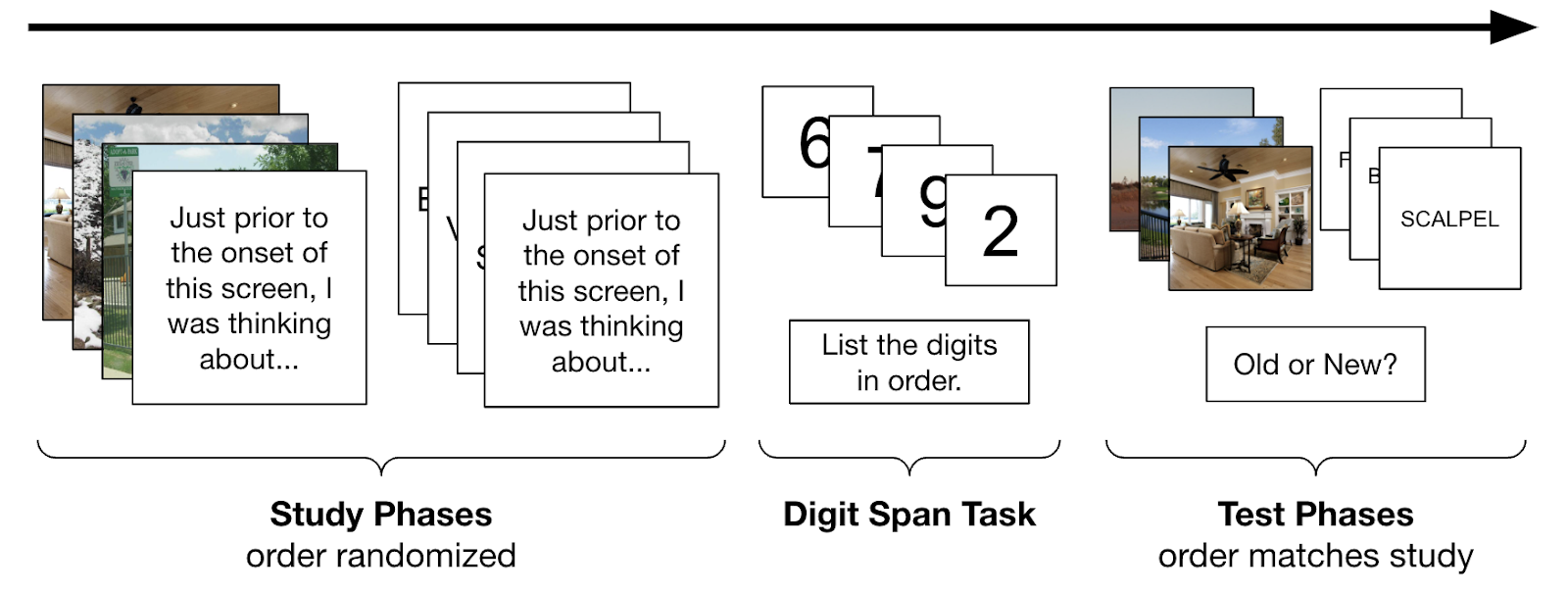
A procedure flowchart of the memory experiment. Participants first studied images and words with intermittent thought probes. Then, they completed a digit span task to prevent information maintenance strategies in working memory. Finally, participants underwent a recognition memory test including previously studied stimuli and intermixed foils.
Memory, Emotion, Thought, and Awareness (META) Lab — UCSB
In the META Lab, we study how fluctuations in conscious experience influence cognitive performance. My work has focused on the role of mind-wandering and internal distraction during memory encoding, particularly in relation to stimulus memorability. Using experience sampling, behavioral experiments, and recognition testing, we aim to understand how internal cognitive states interact with perceptual properties of stimuli to shape long-term memory outcomes. This research sits at the intersection of meta-awareness, attention, and memory.
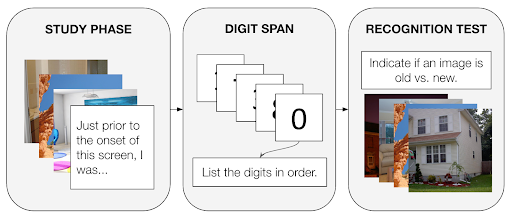
Phases of the procedure for Experiment 1 from a manuscript I contributed to. Participants completed a study phase where they encoded 24 complex visual scenes. Then, after a digit span distractor task, they completed a recognition memory test.
Perception, Cognition, and Action (PCA) Lab — UCSB
Research in the PCA Lab centers on spatial working memory and the neural mechanisms supporting uncertainty representation. I’ve contributed to a series of studies exploring how people encode, maintain, and report imprecise memories for visual locations. These studies incorporate eye-tracking, EEG, and psychophysical methods to investigate moment-to-moment fluctuations in confidence and memory precision. I contributed to multiple projects aimed to understand how visual uncertainty is represented and used when people make decisions about what they remember.
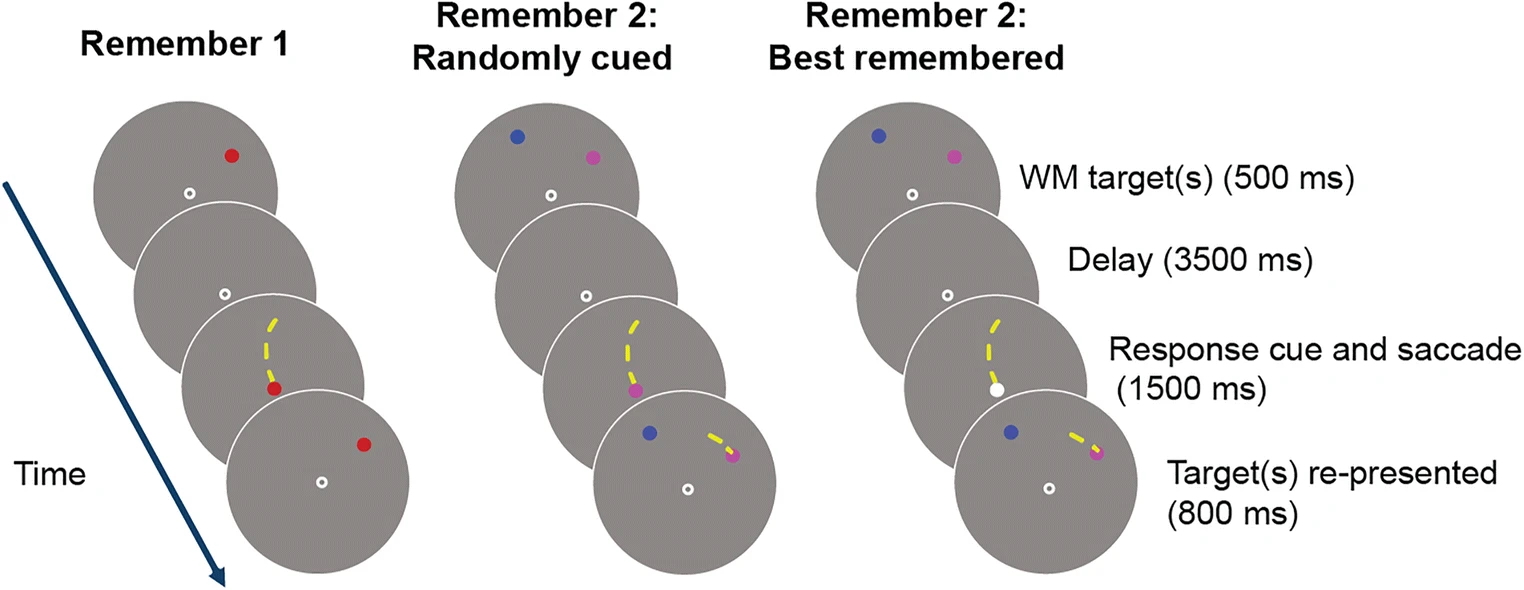
Example task design from Li and Sprague (2023).
Attention Lab — UCSB
The Attention Lab focuses on the dynamics of value-driven attentional capture and cognitive control in complex environments. I contributed to experiments examining how distractor timing and reward learning shape attention in virtual and augmented reality settings. These studies use EEG and behavioral data to assess how motivational salience and environmental context influence attentional filtering. We are especially interested in how attention operates when faced with conflicting or highly distracting information — a key issue in real-world cognition.
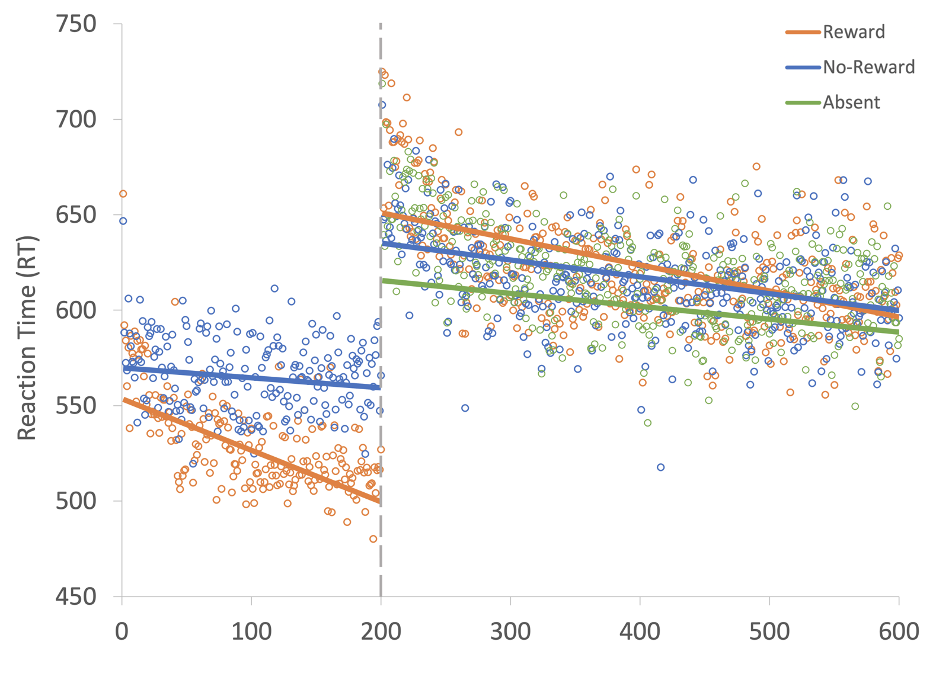
Example plot from Milner et al. (2023).